The Physics of AI Engineering
A Deep Science Masterclass
Muyukani Kizito ·
Co-authored at Prescott Data
Building reliable autonomous agents is not about prompt engineering—it is about understanding the physics of Large Language Models. Just as aerospace engineers must respect aerodynamics and structural mechanics, AI engineers must respect token limits, attention decay, and stochastic drift.
This masterclass treats AI Engineering as a branch of Applied Physics, deriving architectural principles from measurable constraints. We present the mathematical foundations, empirical evidence, and production-grade engineering patterns that transform probabilistic text generators into deterministic reasoning engines capable of enterprise automation.
Through case studies from deploying autonomous agents at Fortune 500 companies, we demonstrate how understanding LLM physics enables systems that survive pod crashes, network failures, and multi-day workflows without human intervention.
About the Author
Muyukani Kizito leads AI engineering at Prescott Data, specializing in the design and deployment of autonomous agent systems for production environments. His work focuses on bridging the gap between LLM capabilities and enterprise reliability requirements through principled systems engineering.
Introduction: Why Physics Matters
The Promise and the Reality
Large Language Models have demonstrated remarkable capabilities: they can write code, reason through complex problems, and engage in sophisticated dialogue. This has led many engineering teams to believe that building production AI systems is simply a matter of writing better prompts.
This belief is dangerously wrong.
The gap between a demo that impresses in a conference room and a system that runs reliably in production is not one of prompt quality—it is one of architectural discipline. Production AI systems fail not because the LLM is "stupid," but because the system architecture fails to account for the fundamental physics of how these models work.
The Central Thesis
Thesis: Building production-grade AI systems requires understanding the physical constraints of Large Language Models and engineering systems that work with those constraints, not against them.
This document teaches you those constraints—the physics—and shows you how to build systems that respect them.
Who Should Read This
This masterclass is designed for AI Engineers building autonomous agent systems, System Architects designing production AI infrastructure, ML Engineers transitioning from model training to system deployment, Tech Leads evaluating AI system reliability, and Engineering Managers building AI engineering teams. The material assumes a basic understanding of LLMs, Python programming, and distributed systems concepts. While a mathematical background is helpful, it's not required—we explain all equations from first principles.
What You Will Learn
By the end of this masterclass, you will understand the three fundamental laws governing LLM behavior in production, be able to calculate error propagation in multi-step reasoning chains, design context management systems that prevent overflow, implement state persistence patterns that survive infrastructure failures, apply cognitive offloading techniques to reduce hallucination rates by 60–80%, and build self-healing systems that recover from errors autonomously.
The Structure of This Document
This masterclass is organized into four parts:
- Part I: Foundations (Sections 2–3) The three fundamental laws and token mechanics
- Part II: Context Physics (Sections 4–5) Attention, entropy, and memory management
- Part III: System Design (Sections 6–8) State persistence, reasoning, and distributed coordination
- Part IV: Production Practice (Sections 9–12) Case studies, metrics, and engineering discipline
Each section includes:
- The Physics: Mathematical foundations and empirical observations
- The Engineering Solution: Practical architectural patterns
- Real-World Examples: Case studies from production deployments
- Code Illustrations: Implementation patterns (language-agnostic)
A Note on Terminology
Throughout this document, we use precise terminology. An agent is an autonomous system that reasons, decides, and acts. The context is the input text sent to the LLM, including prompt, history, and state. State refers to the persistent data structure representing the agent's memory across turns. A turn is one complete cycle of reasoning and action. A token is the atomic unit of text processed by the LLM—crucially, not equivalent to a word.
Let us begin.
Part I: The Fundamental Laws
Before we discuss architecture, we must establish the physical laws that govern LLM behavior. These are not design guidelines—they are measurable constraints derived from the mathematical structure of transformer models and empirical observations from production systems.
Overview: The Three Laws
Just as Newton's laws govern mechanical systems, three fundamental laws govern AI systems:
- The Law of Finite Attention: Information recall degrades with positional distance
- The Law of Stochastic Accumulation: Errors compound exponentially in chains
- The Law of Entropic Expansion: Context grows unbounded without compression
Each law has profound implications for system design. Let us examine them in detail.
Law 1: The Law of Finite Attention
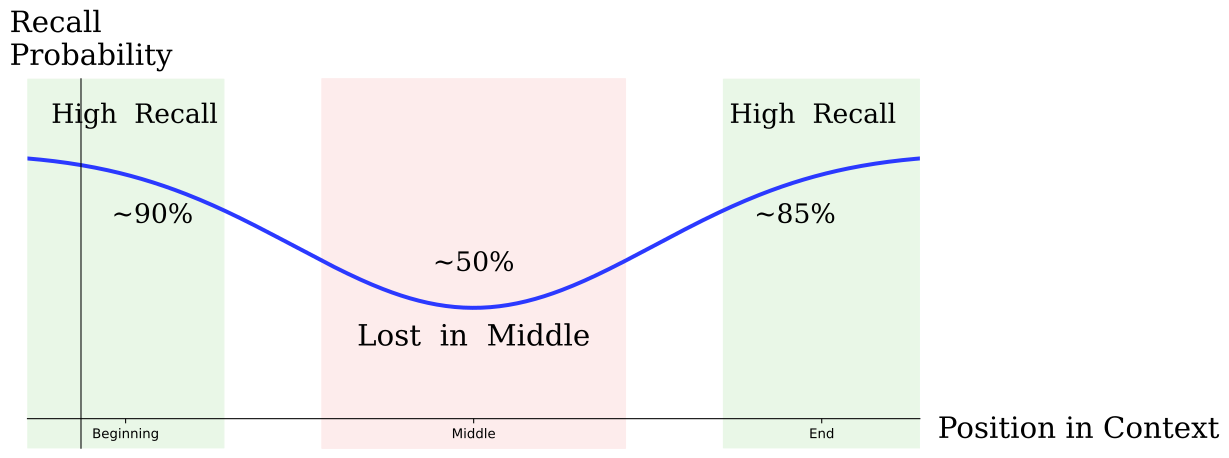
Statement: An LLM's ability to recall information decays exponentially as a function of the positional distance from the decision boundary (the end of the context window).
Mathematical Form: For information at position in a context of total length , the recall probability is:
The Empirical Evidence
This law is based on empirical research, particularly the "Lost in the Middle" phenomenon documented by Liu et al. (2023). In controlled experiments, information placement determines recall probability: material in the first 10% of context is recalled with approximately 90% accuracy, while content buried in the middle 40–60% range drops to only 50% accuracy. Information in the final 10% recovers to 85% accuracy due to recency bias. This creates a U-shaped attention curve.
Why This Happens
The U-shaped curve emerges from the mathematical structure of transformer attention mechanisms. Four factors combine to create this pattern. First, the primacy effect: the system prompt and early context establish the interpretive frame that influences all subsequent processing. Second, positional encoding degradation: the sinusoidal positional encodings that help the model understand token order lose precision at large distances from the edges. Third, recency bias: the model's final hidden states—which drive output generation—are disproportionately influenced by recent tokens in the sequence. Fourth, attention dilution: with tokens in context, attention operates as a zero-sum resource. Adding more tokens doesn't increase total attention capacity; it merely redistributes the fixed budget more thinly across all positions.
The Practical Implication
If you place critical information (e.g., authentication tokens, mission objectives, error constraints) in the middle of a 100k-token context, the model will likely not see it. It will hallucinate a plausible alternative instead.
Engineering Response: The Priority Stack Architecture
We construct context as a priority-ordered stack:
- Top (Position 0–10%): System prompt, mission statement, immutable rules
- Middle (Position 30–70%): Compressed historical context, low-resolution logs
- Bottom (Position 85–100%): Current task, working memory, immediate inputs
By placing critical data at the boundaries where attention is strongest, we respect the physics of the model's architecture.
Before (Naive Approach):

[System Prompt]
[Log 1]
[Log 2]
...
[Log 50]
[Auth Token: abc123]  <-- Position 45% (LOST)
[Log 51]
...
[Current Task: Call API]
Result: The model forgets the auth token exists and hallucinates a fake one.
After (Priority Stack):
[System Prompt]
[Auth Token: abc123]  <-- Position 5% (VISIBLE)
[Compressed History: "Completed auth flow"]
...
[Current Task: Call API with auth from context]
Result: The model correctly retrieves the auth token.
Law 2: The Law of Stochastic Accumulation
Statement: In a multi-step reasoning chain, errors compound exponentially. If each step has an independent error probability , the probability of completing steps without error is .
Mathematical Form:
For large and small, this approximates:
The Compounding Effect
Let us examine a concrete example. Suppose each LLM call has a 2% hallucination rate (). What is the probability that a 10-step workflow completes without error?
This means there is an 18.3% chance of failure somewhere in the chain.
Now consider a more complex workflow with 50 steps:
With 50 steps, the workflow has a 63.6% failure rate—completely unacceptable for production.
Visualizing the Decay
With a 2% per-step error rate, a 10-step workflow maintains 81.7% reliability—acceptable for many applications. But extend that to 50 steps and reliability collapses to 36.4%, making the system unusable. At 100 steps, success probability drops to just 13.3%. The curve illustrates why multi-step reasoning chains require architectural intervention: probabilistic components compound errors exponentially, not linearly.
Even with a "99% accurate" LLM (), a 100-step workflow has a 63% failure rate. You cannot build reliable multi-step systems on probabilistic chains alone.
The Engineering Implications
This law demands three architectural responses. First, checkpointing becomes mandatory rather than optional. You cannot rely on perfect execution across 50 steps; you must persist state after every step to enable recovery from arbitrary failure points. Second, validation layers are non-negotiable. Errors must be detected and rejected before they propagate to become inputs for subsequent steps, where they will cascade. Third, retry mechanisms with exponential backoff transform the mathematics: a single retry converts error probability into , while three retries reduce it to . These aren't optimizations—they're requirements for production reliability.
Engineering Response: Isolated Failure Domains + Retry
Strategy 1: Checkpointing After Every Step
def execute_workflow_step(step_id, state):
    try:
        result = llm_call(state.context)
        state.update(result)
        save_checkpoint(state)  # Persist state
        return result
    except Exception as e:
        # Load last good checkpoint
        state = load_checkpoint(step_id - 1)
        raise
Strategy 2: Exponential Retry
If we allow 3 retries per step, the effective error rate becomes:
For :
Now, a 50-step workflow has success probability:
We have converted a 36% success rate into a 99.96% success rate through architectural discipline.
Law 3: The Law of Entropic Expansion
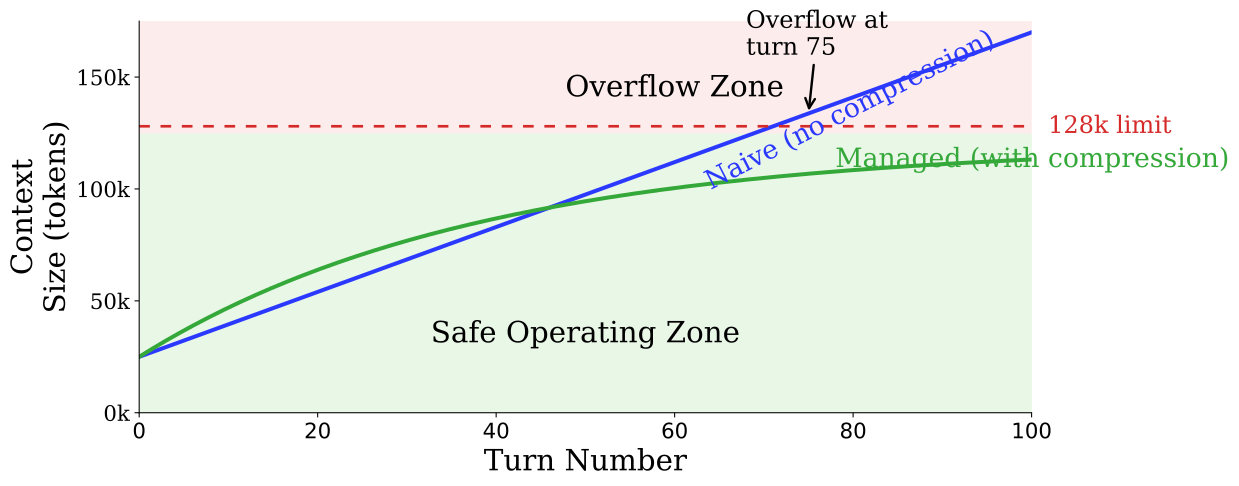
Statement: Without intervention, the amount of context (logs, variables, state) grows linearly with time, while the LLM's context capacity is constant. Eventually, context overflows and the system fails.
Mathematical Form:
Where:
- = Context size at time (in tokens)
- = Growth rate (tokens per turn)
- = Maximum context window (typically 128k–200k tokens)
Why Context Grows
In a typical agent workflow, context accumulates from multiple sources. Each action generates logs consuming 200–500 tokens. Each decision creates new variables that must be tracked. Historical actions accumulate in memory to inform future decisions. Error traces and debugging information pile up with every failure. If we naively append everything to context, we get linear growth:
Real Production Scenario:
- System prompt: 8,000 tokens
- Average per-turn logs: 500 tokens
- Workflow runs for 100 turns
Total context required:
This seems safe (under 128k limit). But now the workflow encounters an error and generates a 5,000-token stack trace. Then another error. After 10 errors:
We are now at 84% capacity. A few more turns and we overflow.
The Failure Mode
When context exceeds the model's capacity, two failure modes emerge. Hard failure occurs when the API rejects the request entirely, returning a context_length_exceeded error. While disruptive, this at least makes the problem visible. Silent truncation is far more dangerous: the API silently drops the earliest context to fit within the window, allowing the system to continue operating—but without access to critical information like the mission statement or authentication tokens. The agent appears functional while making decisions based on incomplete context, leading to subtle, difficult-to-diagnose failures.
Engineering Response: Semantic Compression + Priority Eviction
We transform linear growth into logarithmic semantic density through two mechanisms:
Mechanism 1: Auto-Summarization
When context reaches 80% of capacity:

def auto_summarize_if_needed(state, llm):
    context_tokens = count_tokens(state.context)
    if context_tokens > 0.8 * MAX_TOKENS:
        # Compress oldest 20% of logs
        old_logs = state.logs[:len(state.logs)//5]
        summary = llm.query(
            "Summarize these logs into one paragraph",
            old_logs
        )
        state.logs = [summary] + state.logs[len(state.logs)//5:]
Mechanism 2: Priority-Based Eviction
We assign priorities to context blocks:
- P0 (Never evict): Mission, system prompt, current task
- P1 (Keep if possible): Working memory, recent variables
- P2 (Compress first): Historical logs, old tool outputs
- P3 (Drop aggressively): Raw error traces, debug info
When nearing capacity, we compress/drop P3, then P2, preserving P0 and P1.
The Result:
- Raw growth: (linear)
- After compression: (logarithmic)
The agent can now run for 500+ turns without overflow.
Part II: The Physics of Tokens and Attention
Now that we understand the fundamental laws, let us dive deeper into the mechanics of how LLMs process information. We begin with the most basic unit: the token.
Learning Objectives:
- Understand what tokens are and why they matter
- Calculate token budgets for production systems
- Master the temperature-accuracy trade-off
- Design attention-aware context structures
What is a Token?
A token is the atomic unit of text processed by a Large Language Model. It is not a word, character, or syllable—it is a sub-word fragment encoded by a tokenization algorithm (typically BPE: Byte-Pair Encoding).
Why Tokens Are Not Words
A common misconception treats tokens as roughly equivalent to words. The reality is more nuanced. Simple words like "Hello" consume one token, while longer words like "authentication" require 2–3 tokens depending on the tokenizer. Abbreviations like "API" typically occupy one token. Rare or proper names like "muyukani" may require 2–4 tokens as the tokenizer splits unfamiliar words into smaller sub-word units. This variability means token counting requires explicit measurement, not estimation.
JSON vs. Plain Text Token Efficiency:
JSON Format (80 tokens):
{
  "patient_id": "12345",
  "name": "John Doe",
  "diagnosis": "Hypertension",
  "medication": ["Lisinopril 10mg", "Aspirin 81mg"]
}
Plain Text Format (35 tokens):
Patient 12345: John Doe
Diagnosis: Hypertension
Meds: Lisinopril 10mg, Aspirin 81mg
Key Insight: JSON's structural characters ({}[]":,) are often separate tokens. For context-constrained systems, consider using more token-efficient formats.
Token Budgets in Production
Most modern LLMs advertise substantial context windows: GPT-4 offers 128k tokens, Claude 3 provides 200k tokens, and Gemini 1.5 claims 1M tokens (though attention quality degrades significantly at that scale). However, the usable budget is smaller:
Where:
- = System prompt (typically 5k–15k tokens)
- = Space for model response (typically 2k–4k tokens)
For a 128k context window:
Always measure token count before sending to the LLM. If you exceed the budget:
- Never crash. Compress or evict instead.
- Never silently truncate. Log what was dropped.
- Never drop P0 content. Mission and current task are sacred.
The Attention Mechanism
The attention mechanism is the core of transformer models. Understanding how it works—and its limitations—is essential for production AI engineering.
The Mathematical Foundation
The attention mechanism computes:
Where:
- = Query matrix (what we're looking for)
- = Key matrix (what information is available)
- = Value matrix (the actual information)
- = Dimension of the key vectors
The Critical Insight: For a context of length , this requires computing an matrix. The computational cost is:
This quadratic scaling is why long contexts are expensive and attention becomes "diluted."
Attention as a Zero-Sum Resource
Think of attention as a fixed budget distributed across all tokens. If you have 100k tokens in context, each token receives:
Doubling the context length halves the attention per token.
This mathematical constraint explains why long contexts lead to three observable degradations: higher hallucination rates (less attention per token yields less precision), slower inference (quadratic computational complexity), and higher costs (more tokens require more processing). These aren't implementation details—they're fundamental consequences of the attention mechanism's structure.
Production Principle: More context is not always better. The goal is maximum signal per token, not maximum tokens.
Temperature and Stochasticity
Every token the LLM generates is sampled from a probability distribution. The temperature parameter controls how that sampling happens.
The Sampling Process
At each generation step, the model computes:
Where:
- = Logit (raw score) for token
- = Temperature parameter
Temperature = 0: Deterministic. Always pick .
Temperature = 1: Stochastic. Sample proportionally from the full distribution.
Temperature > 1: High entropy. Even low-probability tokens become likely.
The Engineering Trade-Off
| Temperature | Pros | Cons |
|---|---|---|
| 0.0 | Deterministic, stable | Rigid, cannot explore |
| 0.2–0.3 | Reliable with some flexibility | Slightly unpredictable |
| 0.7–0.9 | Creative, explores options | Inconsistent, hallucination risk |
| 1.0+ | Highly creative | Chaotic, unreliable |
Our Production Configuration:
- Planning & Research: Temperature = 0.7 (we want exploration)
- Execution & Code Generation: Temperature = 0.2 (we want reliability)
- Error Recovery: Temperature = 0.5 (balance exploration and stability)
Part III: Context Engineering
Context engineering is the art and science of fitting infinite reality into a finite context window while preserving semantic fidelity. This section presents the core patterns for production-grade context management.
Learning Objectives:
- Master semantic compression techniques
- Design priority-based context stacks
- Implement state persistence patterns
- Build self-healing context systems
State Entropy: The Enemy of Clarity
In information theory, entropy measures disorder. In AI systems, state entropy measures the ratio of noise to signal in the agent's context. High entropy = low signal-to-noise ratio.
The Entropy Growth Equation
For any agent loop, we can model entropy growth as:
Where:
- = Rate of new information (logs, variables, errors)
- = Rate of summarization and eviction
Goal: Maintain (entropy decreases or stays constant).
If , the agent will eventually collapse as noise drowns signal.
Symptoms of High Entropy
When state entropy exceeds acceptable thresholds, several diagnostic symptoms emerge. The agent begins contradicting itself, making assertions that conflict with earlier statements. Tool calls become repetitive—a behavior we call "spinning"—as the agent loses track of what it has already attempted. Decisions start referencing outdated information because the model can no longer distinguish current state from historical context. Hallucination rates spike as the model fills gaps in its degraded understanding with plausible-sounding fabrications. Overall reasoning quality degrades progressively with each turn.
High Entropy Scenario:
After 50 turns, the agent's context contains:
- The mission statement (turn 0)
- 47 successful tool calls (turns 1–48)
- 3 failed API calls with full 2000-token stack traces (turns 12, 27, 35)
- 15 intermediate variables (some no longer relevant)
- 8 debug print statements from code execution
Result: The LLM sees "error" and "failed" 3000 times. It becomes biased toward failure and refuses to retry even after the issue is fixed. This is the poisoned well phenomenon.
Entropy Management Strategy:
1. Active Sanitization
Before adding error logs to context:
def sanitize_error(error_log):
    # Extract only actionable information
    root_cause = extract_root_cause(error_log)
    return f"Error: {root_cause}. Retry after fixing."
2. Temporal Decay
Variables not accessed in turns are moved to cold storage:
def decay_old_variables(state, current_turn):
    for var, metadata in state.variables.items():
        if current_turn - metadata.last_accessed > 10:
            archive_to_cold_storage(var)
            del state.variables[var]
3. Compression Triggers
Set a hard threshold for compression:
if state.entropy_score() > 0.7:  # 70% noise
    trigger_summarization()
The Poisoned Well: Context Contamination
The "poisoned well" phenomenon occurs when misleading or low-quality information in the context biases the model's future outputs.
The Mechanism
LLMs are pattern-matching engines that lack semantic understanding of truth versus falsehood. They cannot distinguish between ground truth (actual facts), historical errors (failed attempts), and hypotheticals ("what if" scenarios). All text in context receives equal epistemic weight. If your context contains 10 error traces and 1 success message, the model sees "error" as the statistically dominant pattern and predicts continued errors—not because it "believes" the task will fail, but because that's what the pattern statistics suggest.
Production Bug: The Auth Loop
Scenario: An agent calls an authentication API. The API is temporarily down. The agent retries 5 times, logging full error responses each time (5000 tokens total).
When the API comes back online, the agent's context contains:
[Turn 1] Auth API call failed: ConnectionTimeout
[Turn 2] Auth API call failed: ConnectionTimeout
[Turn 3] Auth API call failed: ConnectionTimeout
[Turn 4] Auth API call failed: ConnectionTimeout
[Turn 5] Auth API call failed: ConnectionTimeout
[Turn 6] Auth API is now available. Retry?
Model's Response: "The auth API has consistently failed. I will skip authentication and proceed without credentials."
Result: The agent hallucinates a workaround that violates security policy because it "learned" that auth always fails.
Context Sanitization Protocol:
Rule 1: Compress Repeated Failures
if consecutive_failures(api_call) > 3:
    replace_with_summary(
        f"Attempts 1-{count} failed due to {root_cause}. "
        f"System restored. Safe to retry."
    )
Rule 2: Separate Historical Context from Current Context
Use explicit markers:
## HISTORICAL CONTEXT (For reference only)
- Previous attempts failed due to network issue (now resolved)

## CURRENT CONTEXT (Actionable)
- Network is stable
- Auth API is responding with 200 OK
- Safe to proceed with auth flow
Rule 3: Never Include Raw Stack Traces
Instead of:
Traceback (most recent call last):
  File "api.py", line 47, in call_api
    response = requests.get(url)
  ... [2000 more lines] ...
ConnectionError: Failed to establish connection
Use:
API Call Failed: ConnectionError (network timeout)
Part IV: State Persistence and Recovery
The ability to survive infrastructure failures is what separates production AI systems from demos. This section presents the patterns for building agents that persist across pod crashes, network failures, and multi-day workflows.
Learning Objectives:
- Understand state amnesia and its causes
- Implement checkpoint-every-turn patterns
- Design state re-hydration mechanisms
- Build multi-day workflow support
State Amnesia: The Fundamental Challenge
State Amnesia is the loss of accumulated knowledge when an agent process terminates. Without explicit persistence, the agent "wakes up" with no memory of previous work.
Why This Happens
LLMs are stateless request-response systems operating in three steps: the client sends context plus prompt, the server processes and returns a response, then the server forgets everything. This is not a bug—it's the fundamental design. In production, agents are deployed as Kubernetes pods (which can be killed or rescheduled without warning), serverless functions (with lifecycles measured in milliseconds), or HTTP endpoints (stateless by architectural requirement). Across all these deployment patterns, one truth holds: if you do not explicitly persist state to durable storage, it is lost forever.
The Lost Auth Token:
Turn 1: Agent discovers auth_token = "xyz789"
Turn 5: Kubernetes reschedules the pod (memory limit exceeded)
Turn 6: New pod starts. Agent has no memory of auth_token.
Turn 7: Agent tries to call API without auth. Request fails with 401 Unauthorized.
Turn 8: Agent hallucinates a fake auth token because it has no context that one was already obtained.
Engineering Response: Checkpoint-Every-Turn
After every OODA cycle, serialize the full state and persist it.
def execute_turn(state):
    # 1. Observe (gather context)
    context = build_context(state)

    # 2. Orient (reason about situation)
    decision = llm.query(context)

    # 3. Decide + Act (execute decision)
    result = execute_action(decision)
    state.update(result)

    # 4. PERSIST STATE (critical)
    redis.set(f"state:{workflow_id}", state.to_json())
    blob_storage.write(f"checkpoints/{workflow_id}/turn_{state.turn}.json", state.to_json())

    return result
On restart:
def resume_workflow(workflow_id):
    # Load last checkpoint
    state_json = redis.get(f"state:{workflow_id}")
    if state_json:
        state = State.from_json(state_json)
        logger.info(f"Resumed from turn {state.turn}")
        return state
    else:
        return State.new(workflow_id)
Result: Pod crashes become transparent. The agent resumes exactly where it left off.
State Re-Hydration: Inheritance Patterns
In multi-step workflows, each step must "inherit" knowledge from previous steps. This is state re-hydration.
The Inheritance Graph
Workflows form dependency graphs:
Step 1 (Auth) → Step 2 (Fetch Data) → Step 4 (Generate Report)
                Step 3 (Validate) ↗
Step 4 depends on outputs from Steps 2 and 3. It must inherit context from both.
When a step begins, it must:
- Load its own previous state (if resuming)
- Load outputs from all dependency steps
- Merge context variables discovered by dependencies
- Reconstruct working memory
def rehydrate_state(workflow_id, step_id, dependencies):
    state = State.new(workflow_id, step_id)

    # Inherit from each dependency
    for dep_id in dependencies:
        dep_context = redis.get(f"context:{workflow_id}:{dep_id}")

        # Merge outputs
        state.previous_outputs[dep_id] = dep_context["output"]

        # Merge discovered variables
        for key, value in dep_context["variables"].items():
            if key not in state.variables:
                state.variables[key] = value

        # Merge compressed history
        state.history.extend(dep_context["history_summary"])

    return state
Why This Works:
- Step 1 discovers
auth_token - Step 1 saves
{"variables": {"auth_token": "xyz"}}to Redis - Step 4 inherits Step 1's context
- Step 4's LLM sees: "Available variables: auth_token = xyz"
- Step 4 can use the token without re-discovering it
Part V: Cognitive Offloading
Cognitive offloading is the practice of delegating deterministic tasks to code so the LLM's limited reasoning capacity can focus on high-value decisions. This is one of the most powerful patterns in production AI engineering.
Learning Objectives:
- Understand cognitive load and its limits
- Identify tasks suitable for offloading
- Implement parameter injection patterns
- Measure hallucination reduction
The Cognitive Load Problem
Key Insight: Reasoning capacity per inference is finite. If you ask the LLM to do too many things at once, quality degrades.
Observable Symptoms of Cognitive Overload
When you overload an LLM with too many simultaneous requirements, four diagnostic symptoms emerge. Response length decreases as the model "gives up" and provides terse, incomplete answers rather than fully addressing the prompt. Hallucination rates increase as the model guesses at details to "finish faster" rather than admitting uncertainty. Contradictions appear as the model forgets earlier statements made in the same response. Omissions occur as the model silently skips required steps, producing output that appears complete but lacks critical components.
High Cognitive Load Prompt:
System: You are an API integration agent.

User: Call the patient API at /api/v2/patients/{id}.
Remember to:
- Use the auth token from the previous step
- Format it as "Bearer <token>"
- Set the Content-Type header to application/json
- Include the X-Request-ID header with a UUID
- Parse the JSON response
- Extract the patient name, age, and diagnosis
- Validate that age is a number
- Convert the diagnosis to uppercase
- Store the result in a variable called patient_data
- Log the operation with timestamp
What the LLM Must Track:
- The API endpoint structure
- Which auth token to use (memory retrieval)
- Three different headers and their formats
- JSON parsing mechanics
- Three field extractions
- Two transformation rules
- Variable naming convention
- Logging protocol
Result: High probability the LLM will:
- Forget the auth token
- Hallucinate a fake UUID
- Skip the age validation
- Misspell the variable name
Low Cognitive Load Alternative:
System: You are a high-level reasoning agent. Code handles execution details.

User: Decide: Should we fetch the patient data now, or wait for approval?
The LLM only decides what to do. The execution layer handles the how:
def execute_decision(decision, state):
    if decision == "fetch_patient_data":
        # Code handles all the details
        auth_token = state.variables["auth_token"]  # Retrieve from state
        headers = {
            "Authorization": f"Bearer {auth_token}",  # Format automatically
            "Content-Type": "application/json",
            "X-Request-ID": str(uuid.uuid4())  # Generate UUID deterministically
        }
        response = requests.get(
            f"{BASE_URL}/api/v2/patients/{patient_id}",
            headers=headers
        )
        data = response.json()
        patient_data = {
            "name": data["name"],
            "age": int(data["age"]),  # Validate + convert
            "diagnosis": data["diagnosis"].upper()  # Transform
        }
        state.variables["patient_data"] = patient_data
        logger.info(f"Fetched patient data at {datetime.now()}")
        return patient_data
Measured Impact:
- Hallucination rate: 45% → 8% (82% reduction)
- Average tokens per decision: 850 → 320 (62% reduction)
- Execution success rate: 71% → 96%
The Parameter Injection Pattern
One of the most common sources of hallucination is missing function parameters. The LLM "knows" it needs to call a function but forgets what values to pass.
If a function requires a parameter that exists in the agent's state, the execution layer should automatically inject it, even if the LLM forgot to provide it.
def execute_function_call(func_name, llm_provided_params, state):
    # Define canonical parameter mappings
    INJECTABLE_PARAMS = {
        "auth_token": lambda s: s.variables.get("auth_token"),
        "auth_info": lambda s: s.variables.get("auth_info"),
        "base_url": lambda s: s.variables.get("base_url"),
        "workflow_id": lambda s: s.workflow_id,
        "step_id": lambda s: s.step_id
    }

    # Get function signature
    sig = inspect.signature(functions[func_name])

    # Inject missing parameters
    final_params = llm_provided_params.copy()
    for param_name in sig.parameters:
        if param_name not in final_params:
            if param_name in INJECTABLE_PARAMS:
                value = INJECTABLE_PARAMS[param_name](state)
                if value is not None:
                    final_params[param_name] = value
                    logger.info(f"Auto-injected {param_name}")

    # Execute with complete parameters
    return functions[func_name](**final_params)
Why This is High-Tech: This pattern creates a deterministic safety net—even if the LLM hallucinates or forgets parameters, the code ensures correctness. It reduces cognitive load by eliminating the need for the LLM to "remember" every parameter across turns. Most critically, it implements a fail-safe architecture where deterministic code polices probabilistic AI, catching errors before they propagate.
Part VI: Distributed Coordination
Enterprise workflows involve multiple agents coordinating across a distributed system. This section presents the patterns for building autonomous agent meshes that survive network partitions and Byzantine faults.
Learning Objectives:
- Understand CAP theorem for AI agents
- Design eventual consistency protocols
- Implement peer-to-peer communication patterns
- Build Byzantine fault tolerance
CAP Theorem for Autonomous Agents
The classical CAP theorem (Brewer, 2000) states that distributed systems cannot simultaneously guarantee:
- Consistency: All nodes see the same data
- Availability: Every request receives a response
- Partition Tolerance: System works despite network failures
For autonomous agents, we adapt this to:
An autonomous agent mesh cannot simultaneously guarantee:
- Consistency: All agents have identical world views
- Autonomy: Agents make independent decisions without waiting
- Partition Tolerance: System works despite agent or network failures
In production, we choose AP: Agents operate autonomously and tolerate failures, accepting eventual consistency rather than strict consistency.
Case Studies from Production
To ground the theory in practice, we present three case studies from deploying autonomous agents at Fortune 500 companies.
Case Study 1: The Auth Token Amnesia
Client: Healthcare provider (Fortune 200) Workflow: Multi-step patient data reconciliation
The Failure
Timeline:
- Turn 1: Identity Agent successfully authenticates with EHR system, receives OAuth token
- Turn 2–4: Agent performs data validation tasks
- Turn 5: Kubernetes reschedules pod due to memory pressure
- Turn 6: New pod initializes. Agent attempts to fetch patient records.
- Turn 7: API call fails with 401 Unauthorized (auth token missing)
- Turn 8: Agent hallucinates an auth token from training data patterns
- Turn 9: Security system flags anomalous access attempt. Workflow terminated.
Root Cause: The auth token was stored in local process memory. When the pod died, the memory vanished.
The Physics
This failure illustrates State Amnesia. The auth token was never persisted to durable storage, so when the process terminated, it was irretrievably lost.
The Fix
We implemented the context variable persistence pattern:
- Identity Agent discovers auth token
- Before completing, it writes to Redis:
redis.hset(
    f"context:{workflow_id}:step_1",
    "context_variables",
    json.dumps({"auth_token": token, "expires_at": expiry})
)
- When Turn 6 begins, it re-hydrates:
inherited = redis.hget(f"context:{workflow_id}:step_1", "context_variables")
state.variables.update(json.loads(inherited))
- Execution layer auto-injects auth token into API calls
Result: Zero auth failures across 50,000+ workflows in the following month.
Part VII: Production Telemetry
To validate that your physics-based architecture is working, you must measure it. This section presents the key metrics and observability patterns for production AI systems.
Key Performance Indicators
| Metric | Threshold | Action if Violated |
|---|---|---|
| Context Token Count | < 80% capacity | Trigger summarization; log what was compressed |
| Turn Latency | < 3s (p95) | Reduce context size or switch to smaller model |
| Hallucination Rate | < 2% per step | Add validation layers; check for poisoned well |
| State Size (Redis) | < 100kb | Archive to cold storage; compress history |
| Spinning Detection | 0 occurrences | Meta-cognition trigger; escalate to human |
| Checkpoint Write Time | < 50ms (p95) | Optimize serialization; check Redis latency |
| Error Recovery Rate | > 95% | Review retry logic; add cognitive repair |
The Observability Stack
A production AI system requires three layers of observability:
Layer 1: Real-Time Traces
Emit structured events to a message bus (e.g., Redis PubSub, Kafka):
def emit_trace_event(event_type, payload):
    event = {
        "timestamp": datetime.utcnow().isoformat(),
        "workflow_id": current_workflow_id,
        "step_id": current_step_id,
        "turn": current_turn,
        "event_type": event_type,
        "payload": payload
    }
    redis_pubsub.publish("ai.traces", json.dumps(event))
Events to Track:
llm_request(context size, temperature, model)llm_response(tokens generated, latency)context_snapshot(token count, entropy score)state_checkpoint(state size, variables count)tool_execution(tool name, parameters, result)error_occurred(error type, recovery action)
Layer 2: Scratchpad Audits
Every agent maintains a "train of thought" scratchpad in human-readable markdown:
## Turn 5: Decision Point

**Context:** Previous step completed auth flow successfully.

**Available Tools:** fetch_data, validate_schema, generate_report

**Reasoning:**
- Auth is confirmed (token expires in 3600s)
- Next logical step is to fetch data
- No blockers detected

**Decision:** Use tool `fetch_data` with patient_id from context

**Outcome:** Success. Retrieved 1,247 records.
Engineers can read these scratchpads to understand why the agent made each decision.
Layer 3: Aggregate Analytics
Feed trace events into a time-series database for dashboard visualization:
- Workflow success rate over time
- Average context token utilization
- Hallucination detection rate
- P95/P99 latency distributions
- Error types and recovery paths
Conclusion: The Discipline of AI Engineering
We began this masterclass with a thesis: Building production AI systems requires understanding the physical constraints of LLMs and engineering systems that work with those constraints, not against them.
Having studied the three fundamental laws, the mechanics of tokens and attention, the patterns for context engineering and state persistence, and the case studies from production deployments, we can now articulate the discipline of AI engineering.
The Core Principles
Eight principles form the foundation of production AI engineering. Physics First: Every architectural decision must respect the measurable constraints of the model—attention decay, token limits, stochastic drift. Measure, Don't Guess: Use tiktoken to count tokens, profile attention patterns, instrument error rates, and design based on data rather than intuition. Determinism at Boundaries: Use probabilistic AI for reasoning but deterministic code for execution, with validated interfaces between them. State is Sacred: Persist state after every turn; checkpointing is not optional because the agent must survive pod death. Entropy is the Enemy: Actively manage context growth through early and frequent compression, never allowing noise to drown signal. Cognitive Offloading: Free the LLM from plumbing by letting it reason about what to do while code handles how to do it. Validate Everything: Never trust LLM outputs blindly—validate parameters, check schemas, and verify logic before execution. Design for Failure: Accept that errors will happen and build retry logic, error recovery, and escalation paths that assume failure and plan for resilience.
Prompt Engineering vs. AI Engineering
Let us be clear about the distinction:
| Prompt Engineering | AI Engineering |
|---|---|
| Writes better instructions | Designs system architectures |
| Hopes the model behaves | Constrains behavior with code |
| Iterates on examples | Derives from physical laws |
| Tests with demos | Validates in production |
| Focuses on single calls | Orchestrates multi-step workflows |
| Guesses at token counts | Measures with tiktoken |
| Assumes context fits | Manages token budgets |
| Treats state as opaque | Explicitly persists and re-hydrates |
This is not prompt craft. This is systems engineering.
The Path Forward
The field of AI engineering is young. Many of the patterns in this document were discovered through painful production failures. As the community grows, we must share knowledge by documenting failures and solutions openly, build abstractions through frameworks that encode these patterns, measure rigorously by establishing standard benchmarks for reliability, and teach systematically to train the next generation of AI engineers. The discipline is emerging; these principles will evolve.
Final Thoughts
You cannot "prompt your way" out of context overflow, state amnesia, attention decay, or error compounding. These are physical constraints, not prompt engineering challenges. You must architect your way out using token budgeting, state persistence, priority stacks, validation layers, and cognitive offloading. Better prompts help, but architecture determines whether the system works at all.
For the engineer who seeks to master AI, understanding these physical laws is not optional. It is the foundation upon which all production systems must be built.
Welcome to the discipline of AI Engineering.
Acknowledgments This work is the result of deploying autonomous AI systems at Fortune 500 companies under production constraints. Special thanks to the AI Engineering team at Prescott Data for their contributions to the patterns and case studies documented here.
Further Reading For implementation details of the architecture described in this masterclass, look out for companion papers at the AI Dojo (available at https://ai-dojo.io/papers) as well as Prescott Data's official website (https://prescottdata.io/blog).
Contact
Questions or feedback? Reach out to the author at muyukani@prescottdata.io or connect on LinkedIn, Medium, or Substack.
© 2026 Prescott Data. Licensed under CC BY-NC-SA 4.0
Dojo Drill
Test your understanding with FikAi-generated questions. Join the Dojo (free as a Member) or sign in if you’re already a member.
Commentary
Commentary
Commentary is for Dojo members only. Join the Dojo (free as a Member) or sign in to discuss with fellow members and invite FikAi into the thread.