The Hydra Pattern
Ephemeral Swarms and Fractal Cognition
Muyukani Kizito ·
Co-authored at Prescott Data
About This Series
This document is Volume 2.5 of The Physics of AI Engineering, positioned between Volume 2 (Sub-Agent Control Patterns) and the planned Volume 3 (Memory Architecture). Volume 1 established the three fundamental laws governing LLM behaviour in production. Volume 2 applied those laws to vertical delegation: the Kernel-to-specialist relationship and control hierarchy. This volume addresses a fundamentally different problem: horizontal scaling within a single cognitive domain.
Abstract
Volume 2 demonstrated how to build reliable multi-agent systems by centralising control in the Kernel and distributing specialised intelligence across distinct epistemic domains. That architecture solves the vertical coordination problem: how a generalist orchestrator delegates work to domain specialists.
It does not solve the horizontal concurrency problem: what happens when a single specialist encounters not one task but ten concurrent tasks, all within its domain?
This volume presents the Hydra Pattern, a production-grade architecture for recursive agent spawning. A specialist agent detects a parallelisable workload, fractures it into ephemeral micro-agents running concurrently, and aggregates their findings deterministically. The pattern respects all three fundamental laws from Volume 1 while achieving 10–20 wall-clock speedup on naturally parallelisable workloads: graph exploration, batch document analysis, multi-target investigation.
Six mechanisms make this possible: dynamic spawning, resource cloning, epistemic inheritance, swarm boundary discipline, bounded leases, and the Dehydra aggregation phase. Together they ensure that cognition can be fractured and reconstituted without violating the laws of finite attention, stochastic accumulation, or entropic expansion.
We further document two failure modes that emerge specifically when the Hydra Pattern is deployed inside a multi-agent peer mesh. The first is the Hydra-Peer Deadlock: a cyclic distributed deadlock that forms when two Hydra-capable agents communicate synchronously while each is running its own swarm. The second is Head-of-Line Blocking: heavyweight swarm calls starving lightweight coordination calls that share a single concurrency gate. Both have production-grade architectural solutions — the Asynchronous Actor Model with per-agent mailboxes, and the Dual-Lane Semaphore — which this volume derives and validates.
Keywords: Hydra Pattern, Recursive Agent Spawning, Ephemeral Micro-Agents, Entropy Sinks, Resource Cloning, Epistemic Inheritance, Swarm Boundary Discipline, Fractal Cognition, Asynchronous Actor Model, Dual-Lane Semaphore, Hydra-Peer Deadlock, LLM Physics
Prerequisites: Familiarity with Volume 1 (The Three Laws) and Volume 2 (Sub-Agent Control Patterns) is recommended but not required. Key concepts are re-introduced where necessary.
Introduction: The Problem Volume 2 Cannot Solve
From Vertical to Horizontal Scaling
Volume 2's Architecture C+ achieves a 99.2% mission success rate through architectural discipline: centralising control in the Kernel, distributing specialised intelligence to single-domain agents, enforcing role contracts with bounded leases, and using typed boundaries for deterministic failure routing. The architecture is cognitively coherent, epistemically clean, and deterministically repairable.
It has, however, a latency problem.
Consider a specialist agent whose mission is to investigate 12 independent entities concurrently discovered during a graph traversal. Each entity might lead to a distinct cluster of interest. Under Architecture C+, the agent must investigate them sequentially: entity one, then entity two, and so on. If each investigation takes an average of eight seconds, the total mission time is 96 seconds.
| Turn | Action | Duration |
|---|---|---|
| 1 | investigate(entity_1) | 8s |
| 2 | investigate(entity_2) | 9s |
| 3 | investigate(entity_3) | 7s |
| ... | ... | ... |
| 12 | investigate(entity_12) | 8s |
| Total wall-clock time | 96s |
The agent has not failed. It completes the mission correctly and deterministically. But it has spent 96 seconds on work that is embarrassingly parallel: the 12 investigations share no state, require no coordination, and could run concurrently.
The Sequential Bottleneck
The root cause is architectural, not behavioural. The OODA loop (Observe-Orient-Decide-Act) is sequentially structured by design:
The agent cannot proceed to its next decision until the current action completes. For tasks with ordering dependencies, this is correct and necessary. For independent sub-tasks within a single domain, it is pure latency overhead.
The Sequential Bottleneck. For independent tasks each requiring time , a single-threaded OODA agent requires:
The theoretical minimum under full parallelism is:
For and , sequential execution takes 96 seconds while parallel execution completes in 9 seconds (the duration of the slowest single task). The latency gap is .
The solution is not to make the LLM faster. It is to architect for parallelism.
This Volume's Contribution
Volume 2 solved vertical scaling: distributing intelligence across specialised agents while preserving Kernel control. This volume solves horizontal scaling: enabling a single specialist agent to execute multiple independent tasks concurrently without violating the Three Laws.
The mechanism is recursive spawning with disciplined aggregation, and it carries important consequences for how agents communicate within a peer mesh. Both the pattern and its composition hazards are addressed here.
What You Will Learn:
- Why embarrassingly parallel workloads expose a fundamental latency ceiling in single-agent OODA loops, and why the fix is architectural rather than behavioural
- How the six mechanisms of the Hydra Pattern achieve wall-clock speedup without violating the Three Laws of LLM Physics
- Why resource cloning reduces memory overhead from to , making production swarm sizes feasible
- How epistemic inheritance transfers the parent's world model to every micro-agent without amplifying token cost
- Why swarm boundary discipline must be enforced through tool registry architecture, not prompt instruction
- How the Dehydra aggregation phase guarantees parent context growth regardless of swarm size
- Why Hydra-capable agents embedded in a synchronous peer mesh produce cyclic deadlocks—and how the Asynchronous Actor Model eliminates the failure class entirely
- How the Dual-Lane Semaphore prevents Head-of-Line Blocking without sacrificing Heavy Lane throughput, and how it migrates cleanly to provisioned throughput deployments
The Hydra Pattern: Architecture and Mechanisms
Definition
The Hydra Pattern. The Hydra Pattern is a recursive agent spawning architecture in which a parent agent dynamically creates ephemeral child agents (micro-agents) to execute concurrent sub-tasks within the parent's epistemic domain. The parent retains strategic control; the micro-agents execute narrowly scoped operations and terminate upon completion, yielding structured findings back to the parent. The parent aggregates the results deterministically and synthesises a unified response.
The terms Hydra and Dehydra were coined at Prescott Data to name the two phases of this pattern: the outward fracturing of cognition into a swarm, and the inward reconstitution of findings into the parent. Readers familiar with distributed systems will note the deliberate parallel with fan-out and fan-in; the names were chosen to convey that same duality while grounding the pattern in its mythological intuition.
The name derives from Greek mythology: the multi-headed serpent whose heads multiply when severed. In this architecture, a single agent spawns multiple concurrent instances of itself, each focused on a distinct sub-objective. Six mechanisms govern how this is done without violating the Three Laws.
Dynamic Spawning: The Hydra Phase
The parent agent detects a parallelisable workload and decides to spawn. Crucially, this is an LLM decision, not hardcoded routing logic. The agent reasons over its context, identifies a set of independent targets, and invokes a spawning tool:
deploy_micro_agents(sub_missions=[
    {"target": "entity_A", "objective": "Identify co-occurrence patterns"},
    {"target": "entity_B", "objective": "Verify registration status"},
    ...
])
This is architectural delegation, not just parallelism. Each micro-agent receives a narrow, bounded objective along with the parent's full cognitive context as an immutable baseline.
Resource Cloning
A naive implementation would spawn each micro-agent as a fully independent process, duplicating every heavy resource: the connection pool, the in-memory engine, statistical model instances, and internal caches. For 12 concurrent micro-agents, this can mean 9–12 GB of memory to perform work that the single parent agent handles in under 1 GB.
The Hydra Pattern avoids this through resource cloning. A shallow copy of the parent's tool object is created for each micro-agent. The shallow copy shares all expensive, read-only objects by reference while isolating only the lightweight per-mission identifier that determines where results are written. The formula for total memory under cloning is:
where is the cost of the heavy shared resources, is the cost of lightweight per-agent state, and is the swarm size. For representative values of and :
| Swarm size | Naive (MB) | Cloned (MB) | Saving |
|---|---|---|---|
| 4 | 3,200 | 820 | 74% |
| 8 | 6,400 | 840 | 87% |
| 12 | 9,600 | 860 | 91% |
Resource cloning is what makes the Hydra Pattern computationally feasible at production swarm sizes.
Epistemic Inheritance
When a micro-agent spawns, it requires cognitive context: the domain vocabulary, mission constraints, and patterns already discovered by the parent. Without this context, each micro-agent starts from zero and wastes its limited turn budget re-deriving fundamentals.
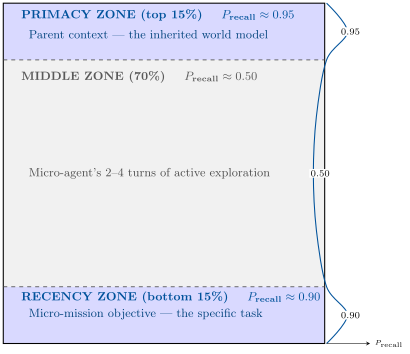
The Hydra Pattern uses epistemic inheritance: the parent's condensed scratchpad is injected into the top of each micro-agent's system prompt, occupying the primacy zone where recall probability is highest (). The specific micro-objective is placed at the bottom of the prompt, in the recency zone (). The micro-agent's own working memory will accumulate in the middle zone during its 2–4 turns of exploration. This placement is deliberate, not incidental.
Epistemic inheritance: the parent's world model is stamped into every micro-agent at spawn time.
micro_mission_prompt = (
    f"PARENT CONTEXT (YOUR INHERITED KNOWLEDGE):\n{parent_scratchpad}\n\n"
    f"YOUR MICRO-MISSION:\n"
    f"Target: {target_id}. Objective: {objective}\n"
    f"Focus strictly on this objective. Report findings and terminate.\n"
)
The token cost of this inheritance is a one-time injection, not a recurring overhead. A micro-agent with a five-turn budget generates at most 2,500 additional tokens across its lifetime, for a total context cost of approximately 17,700 tokens.
Epistemic Inheritance vs. Sequential Execution. For parallel micro-agents with parent context , per-micro-agent generation cost , and per-turn context growth :
For , , , , :
Token cost under both models is comparable—sometimes slightly lower in parallel due to the absence of per-turn context growth in the parent. The wall-clock speedup, however, is or more.
Swarm Boundary Discipline
With 12 micro-agents running concurrently, any one of them encountering an obstacle might attempt to escalate: requesting validation from a peer agent, spawning its own sub-swarm, or extending its turn budget. All three create serious hazards.
If 12 micro-agents simultaneously contact a peer agent, that agent receives 12 concurrent requests, its mailbox overflows, and its token budget is consumed by context from 12 partial investigations rather than one synthesised report. If a micro-agent attempts to spawn its own swarm, the system recurses without bound. If micro-agents extend their leases, the parent never receives control.
The Hydra Pattern enforces three architectural constraints simultaneously:
- The peer communication tool is absent from every micro-agent's tool registry. An agent cannot invoke a capability it does not know exists.
- The spawning tool (
deploy_micro_agents) is similarly absent from micro-agent tool registries. Recursion is impossible because the entry point to it does not exist at the micro-agent level. - Each micro-agent is initialised with
max_steps <= 5. This bounded lease ensures the micro-agent cannot accumulate enough cognitive budget to evaluate whether it should spawn, even if the tool were somehow available.
Swarm Traffic Control. Only the parent agent may contact peer agents. After the Dehydra aggregation phase, the parent synthesises all micro-findings into a single coherent payload and dispatches one message to the peer. This preserves the peer's attention budget and ensures it receives complete synthesised context rather than partial fragments.
Domain-Restricted Spawning. The spawning capability should be granted exclusively to agents whose domain work is naturally parallelisable. Execution-oriented agents — those traversing a graph, processing a document set, or probing independent targets — are candidates. Research or synthesis agents — those reasoning towards a unique conclusion or generating a unified narrative — are not, because their sub-tasks are inherently sequential and order-dependent.
The Dehydra Phase: Aggregation and Synthesis
When all micro-agents complete, the parent enters the Dehydra phase: it collects structured findings and synthesises them deterministically before injecting anything into its own context window.
The critical discipline here is that the aggregation must not use an LLM call. If the parent asks an LLM to “summarise the 12 findings,” it introduces a stochastic layer that can hallucinate, drop critical details, or conflate distinct patterns. The correct approach uses deterministic code operating on typed result objects:
Anti-pattern vs. correct aggregation. The anti-pattern injects raw findings as prose, causing context growth. Deterministic synthesis keeps parent context growth constant.
# Anti-pattern: raw injection causes 12 x 2,000 = 24,000 tokens of growth
for result in results:
    context += f"\n{result.raw_findings}"

# Correct: deterministic synthesis keeps growth below 1,000 tokens
all_leads   = [l for r in results for l in r.leads]
high_conf   = [l for l in all_leads if l.confidence > 0.7]
total_evid  = sum(len(r.evidence_ids) for r in results)

synthesis = (
    f"Swarm completed: {len(results)} targets investigated, "
    f"{len(all_leads)} leads banked ({len(high_conf)} high-confidence), "
    f"{total_evid} evidence items collected."
)
context += synthesis
The parent's context grows by roughly 500 tokens regardless of swarm size. This is the Hydra Pattern's central guarantee: parent context growth is , not .
The Pattern Under the Three Laws
Running 12 concurrent LLM inferences might appear to multiply the failure surface. This section analyses each of the Three Laws from Volume 1 under Hydra concurrency and shows why the pattern is, in fact, more resilient than sequential execution.
Law 1: Finite Attention
Each micro-agent has its own independent context window, typically 15–20k tokens. The U-shaped recall curve applies to each independently: there is no cross-contamination between micro-agents. The question is whether the epistemic inheritance described in lands in the correct zones.
Figure 1 illustrates the deliberate placement: parent context in the primacy zone (recall ), the specific objective in the recency zone (recall ), and the micro-agent's working memory accumulating in the middle zone during exploration. The middle zone receives lower recall (), but this is acceptable because the micro-agent is actively reasoning about that content turn-by-turn. The two pieces of information most critical to the micro-agent's mission — where it comes from, and what it must do — are both in high-recall zones.
Law 2: Stochastic Accumulation
A micro-agent operating for five turns has an individual success probability of . This sounds low, but the Hydra Pattern converts individual failure risk into mission resilience through independence.
When micro-agents fail, they fail independently. If one of 12 micro-agents encounters an error, the remaining 11 continue unaffected. The parent receives 11 successful findings and one failure report. Compare this to sequential execution, where a failure on investigation seven requires the parent to decide whether to retry, skip, or abort before investigations eight through twelve can begin. Under the Hydra Pattern, investigations eight through twelve complete in parallel with the analysis of the failure. More information arrives at the decision point, enabling a better decision.
For a mission defined as “find at least high-confidence leads from targets,” the mission success probability is not 0.77 but rather the probability that at least of micro-agents succeed:
For , : . An individual micro-agent success rate of 77% produces a mission success rate of 99.98%.
Law 3: Entropic Expansion and the Entropy Sink
The Law of Entropic Expansion states that context entropy grows monotonically in the absence of active management. A parent doing 12 sequential investigations accumulates 12 turns of logs, tool outputs, intermediate reasoning, and dead-end traces. By the twelfth investigation, the context is saturated with the cognitive debris of the previous eleven.
Micro-agents solve this through a mechanism we call the Entropy Sink. Each micro-agent is a disposable context container. It absorbs exploration noise, trial-and-error loops, and dead-end reasoning internally. When it terminates, the noise is destroyed alongside the agent — it never crosses back to the parent. Only the structured result object survives the boundary.
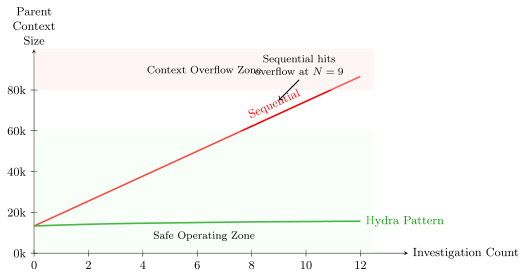
Entropy Containment. For a parent agent with initial context investigating targets, where each investigation generates tokens of logs and noise:
- Sequential:
- Hydra:
The Hydra Pattern bounds parent context growth regardless of swarm size.
The Entropy Sink is the Central Guarantee. The Hydra Pattern is not primarily a speedup mechanism. It is an entropy management mechanism that produces speedup as a consequence. Each micro-agent is a disposable context container: it absorbs the cognitive debris of exploration — dead ends, error traces, intermediate reasoning — and carries it to destruction at termination. Only the structured result object survives the boundary. This is why parent context growth is rather than : swarm size is irrelevant to parent entropy accumulation. The wall-clock improvement is real, but it is the entropy guarantee that makes the pattern safe at production scale.
Figure 2 illustrates the divergence: sequential execution drives the parent context toward the overflow threshold linearly as investigation count grows, while the Hydra Pattern maintains a nearly flat trajectory.
Implementation
Tool Design and the Spawning Contract
The spawning capability is exposed to the parent agent as a single tool. Its presence in an agent's tool registry is what grants spawning capability; micro-agents simply do not have it. The tool accepts a list of sub-missions, each specifying a target and an objective, and returns a deterministic synthesis once the swarm completes.
End-to-End Execution
The listing below shows the complete execution path: from sub-mission construction through epistemic inheritance, resource cloning, isolation, concurrent execution, and deterministic aggregation.
async def _handle_deploy_micro_agents(self, args: Dict[str, Any]) -> str:
    sub_missions   = args.get("sub_missions", [])
    parent_context = self.memory.read_notes()       # Epistemic inheritance source
    parent_id      = self.state.mission_id

    async def run_micro_agent(sm: Dict, index: int) -> MicroAgentResult:
        target    = sm.get("target")
        objective = sm.get("objective")

        # 1. Epistemic inheritance: parent world model at top, objective at bottom
        micro_mission = (
            f"PARENT CONTEXT (YOUR INHERITED KNOWLEDGE):\n{parent_context}\n\n"
            f"YOUR MICRO-MISSION:\n"
            f"Target: {target}. Objective: {objective}\n"
            f"Focus strictly. Bank findings locally. Terminate when done.\n"
        )

        # 2. Instantiate micro-agent (fresh cognitive state)
        micro = AgentClass()
        micro.llm = self.llm  # Shared LLM client

        # 3. Resource cloning: shallow copy shares engine, pool, caches
        micro_id    = f"{parent_id}-micro-{index}-{uuid4().hex[:4]}"
        micro.tools = self.tools.clone(micro_id)

        # 4. Bounded token budget (5-turn task needs far less than the parent)
        micro.context_manager = ContextManager(
            BudgetConfig(total_tokens=50_000, history_limit=10_000)
        )

        # 5. No peer mesh: enforce swarm boundary discipline
        micro.peers = None

        # 6. Execute with bounded lease
        final_state = await micro.run_mission(
            mission=micro_mission, max_steps=5, mission_id=micro_id
        )

        # Dehydra extraction: return only structured findings
        return MicroAgentResult(
            micro_id=micro_id,
            target=target,
            leads=[l.model_dump() for l in final_state.leads],
            findings=micro.memory.read_notes()[-500:],
            status="success" if final_state.finished else "incomplete"
        )

    # Concurrent execution via asyncio
    results = await asyncio.gather(
        *[run_micro_agent(sm, i) for i, sm in enumerate(sub_missions)]
    )

    # Deterministic aggregation: no LLM call, pure signal extraction
    all_leads  = [l for r in results for l in r.leads]
    high_conf  = [l for l in all_leads if l["confidence"] > 0.7]
    successful = [r for r in results if r.status == "success"]

    for r in results:
        self.memory.write_note(f"[{r.target}]: {r.findings}")

    return (
        f"Swarm complete: {len(successful)}/{len(results)} micro-agents succeeded. "
        f"{len(all_leads)} leads banked ({len(high_conf)} high-confidence). "
        f"Details written to scratchpad."
    )
The Concurrency Model: Why Asyncio
The Hydra Pattern relies on Python's asyncio.gather for concurrent execution, not on threads or multiprocessing. The choice is not arbitrary.
Python's Global Interpreter Lock (GIL) prevents true CPU-level parallelism in threads, but LLM API calls are network-bound rather than CPU-bound. An asyncio coroutine yields control at every await, allowing other coroutines to run. When all 12 micro-agents simultaneously await an LLM response, they all yield, and as responses arrive they resume in order. All 12 share one event loop, one process, and one memory space, which is precisely what makes resource cloning effective.
Multiprocessing would require serialising every heavy shared object across process boundaries, destroying the memory savings that resource cloning provides. Threading would achieve only partial speedup due to the GIL. Asyncio achieves near-linear speedup at constant memory cost:
Concurrency Model Comparison. For I/O-bound tasks (LLM calls, database queries):
| Model | Speedup | Memory cost |
|---|---|---|
| Threading | ||
| Multiprocessing | (with IPC overhead) | |
| Asyncio |
For and : multiprocessing costs 9.6,GB while asyncio costs 860,MB. Asyncio is the only feasible model for Hydra at production swarm sizes.
Production Performance
Case Study: Large-Scale Concurrent Investigation
Graph Entity Investigation, Production Deployment.
Graph: 240,000 nodes, 1.2M relationships.
Mission: Investigate 14 independent bridge entities identified during an initial orientation pass. Each bridge represented a high-centrality node connecting multiple distinct clusters of interest.
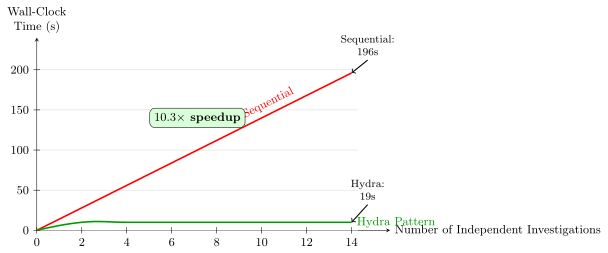
Under sequential execution, each investigation took between 12 and 18 seconds (mean 14 seconds), for a total wall-clock time of 196 seconds. Token cost accumulated to approximately 252,000 tokens, and the parent agent's context had grown to 87,000 tokens by mission end — approaching the 90% threshold at which context quality begins to degrade. Had the mission required further investigations, budget pressure would have forced early summarisation or truncation.
Under Hydra execution, all 14 micro-agents ran concurrently. Wall-clock time was 19 seconds, bounded by the slowest single micro-agent. Token cost was 245,000 tokens — nearly identical to the sequential case. Parent context at mission end was 22,000 tokens, leaving substantial budget for continued exploration.
| Sequential | Hydra | |
|---|---|---|
| Wall-clock time | 196s (3m 16s) | 19s |
| Token cost | 252,000 | 245,000 |
| Parent context at end | 87,000 tokens | 22,000 tokens |
| Remaining mission budget | Constrained | Ample |
| Speedup |
Token Cost: Why Concurrency Is Not More Expensive
A common misconception is that running 12 agents concurrently must consume more tokens than running one sequentially. It does not. Tokens are consumed per LLM inference call, not per unit of wall-clock time. The parent making 14 sequential investigations calls the LLM approximately three times per investigation: once to decide the next action, once to process the tool result, and once to decide the following action. That is 42 inference calls.
Under Hydra, the parent makes one LLM call to decide to spawn, and each micro-agent makes approximately three calls during its five-turn lease. Total: calls. The call count is nearly identical. The speedup comes from the calls occurring concurrently rather than in sequence.
Latency Analysis
The observed speedup is rather than because concurrency does not eliminate overhead. Three components contribute to the critical path:
| Overhead source | Duration |
|---|---|
| Spawn: instantiate micro-agents | |
| Execution: bounded by slowest micro-agent | slowest turn 3 calls |
| Aggregation: gather and synthesise results |
For a longest single micro-agent taking 18 seconds (3 LLM calls 6 seconds each), the critical path is seconds. The theoretical maximum speedup over 196 seconds is , which matches observation closely.
Boundaries and Anti-Patterns
The Hydra Pattern is powerful in its domain but does not apply universally. Three conditions disqualify a workload, and a fourth introduces production-level infrastructure requirements.
Task Dependencies
The pattern applies exclusively to embarrassingly parallel workloads: collections of sub-tasks that are fully independent, share no state, and require no coordination. If task B depends on the output of task A, they cannot run concurrently; the Hydra phase would launch B before A has produced its result. In these cases, sequential execution or an explicit dependency graph orchestrator is the correct approach.
Consider an agent that must authenticate with an API and then fetch data using the resulting credential. Authentication must complete before data retrieval can begin. These are sequential dependencies; applying the Hydra Pattern would launch the data fetch before a valid credential exists.
Shared Mutable State
Resource cloning shares heavy objects by reference using shallow copies. This is safe for read-only resources but creates race conditions for mutable shared state. If multiple micro-agents simultaneously attempt to write to the same database record or update a shared counter, the last write wins and intermediate results are silently discarded.
The correct architecture keeps writes at the parent level: micro-agents perform read-only or append-only operations; the parent performs all mutations after the Dehydra aggregation phase, where findings are collected and any write conflicts can be resolved deterministically.
LLM Rate Limits and the Dual-Lane Semaphore
When a Hydra swarm of micro-agents each makes LLM calls over a duration , the effective request rate is:
If this exceeds the endpoint's rate limit, requests receive HTTP 429 (Too Many Requests) responses. The built-in retry mechanism backs off and retries, but if many requests are simultaneously throttled, they will all retry at approximately the same moment, recreating the same burst. The concurrency benefit is partially or fully destroyed.
Sizing the swarm to the rate limit. Set the maximum swarm size to respect the rate limit:
For , , : . Spawning up to 20 concurrent micro-agents respects the rate ceiling with this configuration.
Correct swarm sizing prevents rate-limit violations. It does not, however, prevent a subtler failure: Head-of-Line Blocking.
Production agent systems typically operate two LLM tiers simultaneously. A heavyweight tier handles deep analytical reasoning — quantitative verification, report synthesis, complex graph traversal — with individual call latencies of 15–60 seconds. A lightweight tier handles coordination: mission planning, peer message dispatch, scratchpad summarisation, with latencies of 1–3 seconds. When a Hydra swarm saturates a unified concurrency gate with heavyweight requests, every lightweight coordination call queues behind them. A 2-second planning call waits 45 seconds for a heavy slot to free. The system does not choke on the rate limit; it chokes on its own cognitive weight.
Head-of-Line Blocking. A unified semaphore assigns no priority. In the worst case, a fast coordination call waits the full duration of the longest active heavyweight request before acquiring a slot. For , a 2-second call may be delayed by up to 45 seconds.
The architectural solution separates heavy and fast calls into independent concurrency gates. Figure 4 illustrates the Dual-Lane Semaphore architecture.
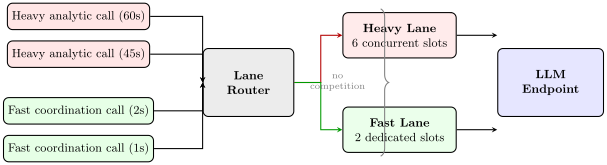
The Dual-Lane Semaphore. Maintain two independent module-level semaphores, one per cognitive tier. Route each LLM call to the appropriate lane based on a deployment naming convention or explicit tier annotation. The Fast Lane holds a fixed small number of dedicated slots (typically 2) that heavyweight calls never acquire. This guarantees a latency ceiling for coordination calls regardless of swarm activity.
Provisioned throughput migration. When a provisioned throughput allocation is available, a single environment variable sets the Heavy Lane slot count to match the provisioned capacity. The architecture guarantees full utilisation without overflow: the Heavy Lane saturates the allocation; the Fast Lane consumes headroom beneath it.
Latency reduction from lane separation. For a unified semaphore of size fully occupied by heavy requests of duration , a new fast request waits:
With the Dual-Lane architecture, the fast request acquires a semaphore that heavy requests never hold:
For and : worst-case coordination latency drops from 45 seconds to 3 seconds, a improvement, at zero cost to Heavy Lane throughput.
Every LLM call in a multi-agent system carries implicit cognitive weight. Route heavy calls (deep reasoning, long context, tool-rich exploration) through a dedicated Heavy Lane. Reserve the Fast Lane exclusively for inter-agent coordination. The two lanes must never compete for capacity.
Composing Hydra with a Peer Mesh: The Async Actor Model
A Failure Mode That Emerges at Composition
The Hydra Pattern and the multi-agent peer mesh from Volume 2 are each independently sound. When they are composed, a new failure mode emerges that neither paper anticipates: a distributed cyclic deadlock.
Consider two agents operating as peers: a Scout and an Analyst. The Scout's role is to traverse a graph and surface high-confidence leads; the Analyst's role is to validate those leads quantitatively. Both are Hydra-capable.
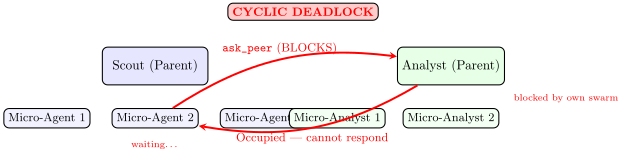
The Scout triggers its swarm and 12 micro-agents run concurrently. One micro-agent discovers a strong pattern and needs Analyst validation. It calls ask_peer(role="analyst", query=...) and blocks, waiting for a response. At the same moment, the Analyst has triggered its own Hydra swarm to process previously received leads. Its concurrency gate is saturated; it has no free capacity to service the Scout's request. The Scout's micro-agent cannot continue. The Analyst cannot clear its queue to respond. Both are waiting on each other.
This is a classical distributed cyclic deadlock: two processes each holding a resource the other requires, each waiting for the other to release it.
Why Prompt Engineering Cannot Fix This
An instinctive response is to instruct micro-agents not to call the peer agent if the peer might be busy. This fails on two counts. First, the micro-agent has no visibility into the peer's internal state; the LLM cannot observe a remote agent's concurrency gate. Second, simply skipping validation is not a solution: unvalidated leads contradict the purpose of having an Analyst peer in the architecture at all.
The problem is structural, not behavioural. It lies in the synchronous communication model: any architecture where one agent blocks waiting for another can produce a cycle under concurrent execution. No prompt instruction can eliminate a structural deadlock.
The Asynchronous Actor Model
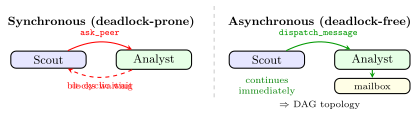
The correct solution abolishes blocking peer requests entirely. Rather than ask_peer — a request that blocks the caller until a response arrives — agents communicate via dispatch_message: a fire-and-forget notification that returns immediately, allowing the caller to continue execution.
Asynchronous Actor Model for Agents. In an asynchronous agent mesh, all inter-agent communication is non-blocking. An agent dispatches a message and immediately continues its own execution. The receiving agent delivers the message to its mailbox and processes it when it has capacity. No agent ever blocks waiting for a peer response.
The critical property this enforces is that the communication graph forms a Directed Acyclic Graph (DAG). Without blocking waits, no cycle can form. Deadlock becomes structurally impossible, not merely unlikely.
The Mailbox and Traffic Control
Each agent server exposes an on_peer_notify handler. When a message arrives, the handler routes it based on the agent's current state: if the agent is actively running a session, the message is appended to an in-memory mailbox queue; if the agent is idle, a background task is spawned immediately to process the new request. The parent reads its mailbox at natural checkpoints between swarm phases or after aggregation, preventing interrupt-driven context switching while guaranteeing that no message is silently dropped.
The Swarm Traffic Control principle from Section extends naturally to the asynchronous model: micro-agents are forbidden from dispatching messages to peer agents, synchronously or asynchronously. Only the parent dispatches, and only after Dehydra aggregation has produced a single synthesised payload. This ensures the peer receives one complete, contextually rich message rather than concurrent partial fragments.
| Property | Synchronous ask_peer | Async dispatch_message |
|---|---|---|
| Caller blocks | Yes | No |
| Deadlock risk | Yes (cyclic wait) | None (DAG enforced) |
| Peer under load | Request blocked at socket | Message queued in mailbox |
| Response path | Synchronous return value | Peer dispatches back async |
| Hydra compatible | No | Yes |
The Composition Invariant. The Hydra Pattern (horizontal scaling) and the Asynchronous Actor Model (peer communication) are mutually reinforcing. Hydra provides the concurrency. The Actor Model provides the communication discipline. Neither is sufficient alone: Hydra without async communication produces deadlocks; async communication without Hydra leaves parallelism untapped. Together, they enforce a DAG communication topology across the entire agent mesh, and a DAG cannot deadlock.
Extensions and Advanced Variants
Recursive Hydra
The question of whether a micro-agent can spawn its own sub-swarm — creating a two-level Hydra — is worth examining directly. In principle, there is no logical barrier to it. In practice, the bounded-lease firewall makes it architecturally infeasible at standard micro-agent budgets.
A micro-agent operating with max_steps=5 would need to spend at least one turn discovering that a sub-swarm is warranted, one turn constructing and dispatching the sub-swarm, and at least one further turn aggregating results and completing its own objective. By turn three, the lease is nearly exhausted and the sub-swarm has not had time to complete a meaningful investigation. The micro-agent's context terminates, and its sub-swarm continues running without a parent to collect its results.
Orphaned Sub-Swarms. If a micro-agent spawns a sub-swarm and then exhausts its own lease before the sub-swarm completes, the sub-agents finish their work, write their findings, and terminate — but no agent is alive to aggregate them. The findings are permanently lost. This failure is silent: the system produces no error, no exception, and no log warning. The parent receives an incomplete result and has no way to detect that an entire sub-swarm's work was discarded. This is the precise reason why the spawning tool must be absent from micro-agent tool registries. The protection is structural, not behavioural: a micro-agent that never has the spawning capability cannot trigger this failure, regardless of what its LLM reasons.
Only the top-level parent agent, with a budget sufficient to spawn and subsequently aggregate a swarm (max_steps ), should have the spawning tool in its registry. Micro-agents are leaves, not branches. The pattern is single-level, not multi-level, at standard budget configurations.
A hierarchical Hydra operating across three levels — parent spawning mid-level coordinators, which spawn micro-agents — would require a mid-level coordinator budget of 20–30 steps. This is technically feasible but introduces additional complexity in epistemic inheritance across three levels and is left as future work (see Section ).
Federated Hydra: Cross-Silo Swarms
An advanced variant applies the Hydra Pattern across data silos. Rather than spawning micro-agents to explore different entities within a single database, the parent spawns micro-agents that each connect to a different isolated database instance. Each micro-agent sees only its assigned silo; the parent synthesises findings across all silos without any silo ever accessing another's data.
This Federated Hydra Pattern enables zero-leakage cross-silo investigation. It is a logical extension of the core pattern and follows the same mechanics: resource cloning, epistemic inheritance, swarm boundary discipline, and Dehydra aggregation all apply unchanged. The only modification is the database connection routing in the clone() method, which assigns a different connection string to each micro-agent.
Comparison to Related Patterns
Hydra Pattern vs. MapReduce
MapReduce (Dean & Ghemawat, 2004) also distributes work across concurrent workers and aggregates results deterministically. The structural similarity is intentional: the Hydra Pattern is, in a meaningful sense, MapReduce for cognitive workloads. The differences arise from the stochastic nature of LLM inference.
| Aspect | MapReduce | Hydra Pattern |
|---|---|---|
| Workload type | Data processing (deterministic) | Exploration and reasoning (stochastic) |
| Worker type | Stateless pure functions | Stateful cognitive agents |
| Coordination | Centralised scheduler | Parent LLM (reasoning-driven) |
| Fault tolerance | Retry the failed task | Partial swarm success is mission success |
| Result aggregation | Deterministic reduce function | Deterministic code on typed result objects |
Table: The Hydra Pattern shares MapReduce's structural decomposition but adapts each component for the physics of LLM cognition. Stochastic accumulation replaces deterministic computation; mission-level success probability replaces per-task reliability; and typed result objects replace raw data outputs.
Hydra Pattern vs. the Actor Model
The Actor Model (Hewitt, 1973) describes concurrent computation as a collection of long-lived actors communicating via asynchronous message passing, each maintaining private state and processing one message at a time. Section introduced the Asynchronous Actor Model as the correct communication discipline for Hydra-capable agents. The structural relationship is worth making explicit.
The Hydra Pattern differs from the classic Actor Model in three ways. First, micro-agents are ephemeral: they spawn, execute, and are garbage-collected, unlike persistent actors. Second, the communication topology is hierarchical rather than flat: micro-agents communicate only with their parent, not with peers or siblings. Third, micro-agents are stochastic rather than deterministic: the same input may produce different reasoning paths across invocations.
The Asynchronous Actor Model introduced in Section is precisely a specialisation of the classic Actor Model applied to the parent-level agent mesh: persistent agents communicating via non-blocking message dispatch and per-agent mailboxes. The two patterns are complementary. Hydra handles intra-agent horizontal scaling; the Async Actor Model handles inter-agent coordination.
Engineering Checklist
The following checklist covers everything required before a Hydra implementation goes to production.
Prerequisites
- The workload is embarrassingly parallel: all sub-tasks are independent, share no mutable state, and require no coordination.
- The LLM endpoint's rate limit supports calls across a swarm cycle, where is the average calls per micro-agent.
- Shared resources (connection pools, in-memory engines, caches) are safe for concurrent read access.
- The parent agent has
max_steps $\geq$ 30to accommodate spawning, awaiting, and aggregating a swarm.
Implementation
- The spawning tool is present only in the parent's tool registry; micro-agents do not have it.
- The
clone()method performs a shallow copy sharing all heavy resources, isolating only the per-mission identifier. - Micro-agents are initialised with
peers=None: no peer mesh access. - Micro-agents are initialised with
max_steps $\leq$ 5: bounded lease. - Micro-mission prompts inject parent context at the top (primacy zone) and the specific objective at the bottom (recency zone).
- All inter-agent peer communication uses asynchronous dispatch (
dispatch_message), not blocking requests (ask_peer). - Micro-agents have no peer communication tool of any kind in their registry.
Concurrency and Rate Limit Management
- The LLM client implements a Dual-Lane Semaphore: a Heavy Lane for analytic calls and a Fast Lane for coordination calls.
- Heavy Lane slot count satisfies .
- Fast Lane has at least 2 dedicated slots that the Heavy Lane never acquires.
- Retry logic reads the
retry-afterresponse header when present and falls back to exponential backoff otherwise. - Maximum retry count is at least 7 to absorb transient rate-limit spikes during peak swarm activity.
Safeguards
- Micro-agents return typed result objects, not free-form prose.
- The parent aggregates with deterministic code; no LLM summarisation call touches the aggregation step.
- The synthesised output injected into the parent's context is below 1,000 tokens.
- Swarm size is capped at .
Testing
- Measured wall-clock speedup falls in the range .
- Token cost is approximately equal to sequential cost, not higher.
- Parent context growth is : increasing swarm size does not materially increase parent context size at mission end.
- Logs confirm no micro-agent ID appears as the source of a peer message.
- Under simultaneous two-agent Hydra execution, neither agent hangs indefinitely.
Open Questions and Future Work
This section distinguishes problems that have been resolved in production from those that remain open.
Resolved: The Hydra-Peer Deadlock
The question of how micro-agents should request peer validation without blocking their parent's swarm has been resolved. Synchronous peer requests are eliminated from the architecture entirely. The Asynchronous Actor Model with per-agent mailboxes enforces a DAG communication topology across the mesh. Micro-agents bank findings locally; the parent dispatches a single synthesised payload after Dehydra aggregation.
Resolved: Head-of-Line Blocking
The question of how lightweight coordination calls compete for LLM capacity against heavyweight swarm calls has been resolved. The Dual-Lane Semaphore separates calls by cognitive tier into independent concurrency gates with dedicated slot allocations. Worst-case coordination latency is bounded by , not .
Open: Dynamic Swarm Sizing
The current architecture places swarm-sizing decisions entirely with the parent LLM: the agent reasons over its context and decides how many micro-agents to spawn. A hybrid approach may be more robust: the LLM decides whether to spawn, while the infrastructure decides how many based on live Heavy Lane utilisation, remaining parent turn budget, and workload size. This would prevent over-spawning near context limits and adapt naturally to endpoint load.
Open: Adaptive Micro-Agent Budgets
A fixed five-step lease treats all targets identically. Targets with high centrality in the data graph — many connections, strong structural significance — may warrant larger budgets (max_steps=8); peripheral leaf targets may need only two steps. Dynamic budget assignment based on observable target characteristics would improve both mission depth and token efficiency.
Open: Hierarchical Hydra
A high-budget parent (max_steps=200) could spawn mid-level coordinators (max_steps=30) which in turn spawn micro-agents (max_steps=5), enabling three-level fractal decomposition. The engineering challenge is maintaining epistemic context coherence across three inheritance levels without token explosion. The memory architecture planned for Volume 3 may provide the primitives needed to address this.
Open: Cross-Process Concurrency Coordination
The Dual-Lane Semaphore is process-local: each Python process maintains its own semaphore state. In a horizontally scaled deployment with multiple agent instances sharing a single LLM endpoint, the effective concurrent call count becomes , which may exceed the endpoint's rate limit. A cross-process coordination layer — for example, a Redis-backed token bucket — would enforce a global rate ceiling across the fleet without requiring agents to coordinate explicitly.
Conclusion: Fractal Cognition and the Future of Agent Scale
Volume 2 demonstrated that the path from to mission success rate in multi-agent systems is paved with architectural discipline: centralising control, enforcing role contracts, using typed boundaries, and building deterministic repair routers. Those patterns address reliability.
The Hydra Pattern addresses a different constraint: latency. It proves that a specialist agent can achieve 10–20 wall-clock speedup on parallelisable workloads without sacrificing reliability, exploding memory, or violating the Three Laws. The mechanism is recursive spawning with disciplined aggregation, governed by six mechanisms: dynamic spawning, resource cloning, epistemic inheritance, swarm boundary discipline, bounded leases, and the Dehydra phase.
Two production discoveries round out the picture. When Hydra-capable agents are embedded in a peer mesh, synchronous communication creates cyclic deadlocks. The resolution is architectural: replace blocking peer requests with asynchronous fire-and-forget dispatch and per-agent mailboxes, enforcing a DAG communication topology across the mesh. And when heavy analytic swarms share a single LLM concurrency gate with lightweight coordination calls, Head-of-Line Blocking silently serialises what should be a concurrent system. The resolution is again architectural: the Dual-Lane Semaphore reserves dedicated capacity for coordination, making its latency independent of swarm load.
The deeper insight is that cognition can be fractured and reconstituted, provided three invariants are maintained: resource sharing is explicit (shallow copy for hardware, inheritance for epistemic context); entropy is contained (micro-agents are disposable, and noise dies with them); and aggregation is deterministic (no stochastic LLM call touches critical structured data).
This is not distributed AI in the traditional sense. It is fractal cognition: a single intelligent agent recursively decomposing itself into smaller, faster, narrower instances, then recomposing their findings into a coherent whole. The pattern extends beyond graph exploration to any agent task with naturally parallel sub-tasks: batch document analysis, multi-endpoint validation, parallel hypothesis testing, distributed knowledge search.
Volume 2.5 establishes that agent intelligence can scale horizontally without context collapse.
Volume 3 will address how agent intelligence scales temporally — across sessions, days, and months —
through Memory Architecture and Retrieval-Augmented Cognition.
Glossary of Key Terms
- Asyncio. Python's event-loop-based concurrency model. Enables I/O-bound parallelism (LLM API calls, database queries) without threading overhead or the memory cost of multiprocessing.
- Asynchronous Actor Model. An inter-agent communication architecture in which all peer messages are non-blocking dispatches. No agent blocks waiting for a response. Messages are delivered asynchronously via per-agent mailboxes, and the communication graph forms a DAG, making cyclic deadlock structurally impossible.
- Bounded Lease. A hard turn limit (
max_steps) assigned to a micro-agent, preventing it from accumulating enough cognitive budget to evaluate whether it should spawn its own sub-swarm. Serves as the anti-recursion firewall. - DAG Communication. A communication topology in which no cycle can form between agents. Enforced by replacing blocking peer requests with fire-and-forget asynchronous dispatch, ensuring that a waiting arc can never complete a loop.
- Dehydra Phase. The aggregation and synthesis step in which the parent collects structured results from micro-agents and compresses them into a dense summary (typically under 1,000 tokens) via deterministic code before injecting anything into its own context window.
- Dual-Lane Semaphore. A concurrency architecture maintaining two independent semaphores: a Heavy Lane for deep analytic LLM calls and a Fast Lane for coordination calls. The two lanes never compete, guaranteeing that coordination latency is bounded by regardless of swarm activity.
- Embarrassingly Parallel. A workload in which all sub-tasks are fully independent, share no mutable state, and require no coordination. The Hydra Pattern applies only to embarrassingly parallel workloads.
- Entropy Sink. A disposable context container. A micro-agent absorbs exploration noise, dead-end reasoning, and tool-call traces internally. Upon termination, the noise is destroyed. Only the structured result object crosses back to the parent.
- Ephemeral Agent. An agent instance with a bounded lifetime that spawns, executes a narrow task, and is garbage-collected. Distinguished from persistent agents (parent, peer) by its disposability and isolation.
- Epistemic Inheritance. The transmission of the parent agent's world model (domain vocabulary, mission constraints, discovered patterns) to a micro-agent at spawn time, via injection into the primacy zone of the micro-agent's context window.
- Federated Hydra. A variant of the Hydra Pattern in which micro-agents are each assigned to a different isolated data source, enabling cross-silo investigation without any silo accessing another's data.
- Fractal Cognition. The property of an agent architecture in which intelligence recursively decomposes into smaller, faster, narrower instances of itself (Hydra phase) and then recomposes their findings into a unified whole (Dehydra phase).
- Head-of-Line Blocking. A concurrency failure in which long-running requests in a unified queue delay short requests behind them. In Hydra systems, heavy analytic swarm calls occupy a shared concurrency gate and delay fast coordination calls. Resolved by the Dual-Lane Semaphore.
- Hydra Pattern. A recursive agent spawning architecture in which a parent agent creates ephemeral micro-agents to execute concurrent sub-tasks within its epistemic domain, then aggregates their findings deterministically.
- Hydra-Peer Deadlock. A distributed cyclic deadlock that occurs when two Hydra-capable agents with synchronous peer communication are both running concurrent swarms. Each blocks waiting for the other; neither can proceed. Resolved by the Asynchronous Actor Model.
- Mailbox. A per-agent asynchronous message queue. Incoming peer notifications are appended to the mailbox if the agent is in an active session, or trigger a background task if the agent is idle. The parent reads its mailbox at natural mission checkpoints between swarm phases.
- Resource Cloning. An implementation technique in which micro-agents share expensive read-only resources (connection pools, in-memory engines, caches) via shallow copy while isolating only lightweight per-mission state. Reduces memory cost from to .
- Sequential Bottleneck. The latency penalty of a single-threaded OODA agent executing independent tasks: total time instead of the parallel minimum .
- Swarm Boundary Discipline. The set of architectural constraints preventing micro-agents from contacting peer agents, spawning sub-swarms, or exceeding their turn lease. Enforced via tool registry exclusion, not prompting.
The Three Laws: Volume 1 Summary
For readers who have not read Volume 1, the three fundamental laws are summarised here. All architectural patterns in this volume are derived from them.
The Three Fundamental Laws of LLM Behaviour in Production
Law 1: The Law of Finite Attention.
A transformer's attention mechanism distributes a fixed computational budget across all tokens in the context window. Recall probability follows a U-shaped curve: high at the beginning (primacy), high at the end (recency), and approximately 50% in the middle. Critical information placed in the middle zone has a coin-flip probability of being recalled at decision time.
Law 2: The Law of Stochastic Accumulation.
Every LLM inference is a stochastic event with a per-decision error probability . For sequential decisions, the system success probability is:
For and : . Long decision chains decay exponentially. The correct response is to reduce , not to reduce .
Law 3: The Law of Entropic Expansion.
Context entropy grows monotonically in the absence of active management. Each turn adds tokens; errors add stack traces; history accumulates summaries of summaries. Without compression, eviction, and structured artefact management, every long-running agent workflow ends in context collapse.
These laws apply universally to all transformer-based language models, regardless of model size, training data, or provider. Architectural patterns that ignore them degrade predictably under production load.
Acknowledgements
The Hydra Pattern emerged from a production constraint: traversal missions were taking three to five minutes for workloads that were obviously parallelisable. The initial instinct was to spawn threads, the kind of casual concurrency decision that ignores memory physics and connection pool limits.
The correct solution required reasoning from first principles about what resources are expensive to duplicate and what resources are cheap to isolate. The resource cloning mechanism and the epistemic inheritance pattern are products of that reasoning. The Asynchronous Actor Model and the Dual-Lane Semaphore emerged later, from the failure modes that appeared once both Scout and Analyst agents were running Hydra swarms concurrently in a shared mesh.
The author thanks the AI engineering team at Prescott Data for stress-testing this architecture across multiple production missions before publication, and for providing the failure cases that produced the most important generalisations.
© 2026 Prescott Data.
Licensed under CC BY-NC-SA 4.0
Dojo Drill
Test your understanding with FikAi-generated questions. Join the Dojo (free as a Member) or sign in if you’re already a member.
Commentary
Commentary
Commentary is for Dojo members only. Join the Dojo (free as a Member) or sign in to discuss with fellow members and invite FikAi into the thread.